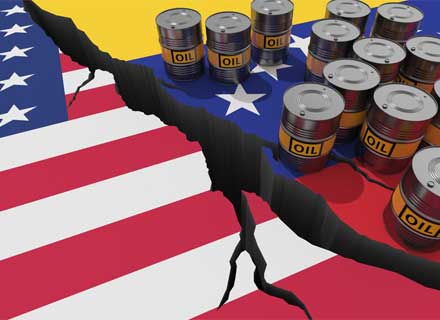
While the interim Caracas government and military leaders praise the economic project, analysts warn of potential corruption, colonial subjugation, and long delays for ordinary citizens.
The pact focuses on 17 oil fields holding an estimated 65 billion barrels of petroleum. US Secretary of Energy Chris Wright was scheduled to arrive in Venezuela to finalize the arrangement.
Military Approval and Financial Projections in Caracas
The Venezuelan military publicly endorsed the arrangement during a televised address following a meeting between interim President Delcy Rodríguez and Defense Minister General Gustavo Gonzalez Lopez.
Under the terms outlined by officials in Caracas, the arrangement is projected to yield 209 billion dollars in gains for Venezuela over a 25-year period. The country’s state-controlled National Assembly voted to support the pact, with officials arguing it will drive international investment, create jobs, and foster national prosperity.
We are going to see a large influx of international investments, which will translate into more jobs, greater production, and all of this spillover effect will generate even more jobs. If you would ask me to define this agreement in a single word, I would say it is prosperity and well-being for the country, as well as for us. General Gustavo Gonzalez Lopez, Defense Minister
US Control and Private Concessions Involving North American Blue Energy Partners
The White House indicated that Washington has secured the right to purchase a portion of the resulting production at cost, alongside an option to buy remaining portions at market rates.
The private entity managing the venture is North American Blue Energy Partners, headed by Venezuelan businessman Alejandro Betancourt. Reports indicate the US administration intervened at high levels earlier in the year to limit the impact of a Swiss judicial inquiry against him and to convince Great Britain to lift travel restrictions.
Analyst Warnings Regarding Corruption and Imperialist Policy
Specialists view the pact as an extension of US foreign policy goals. Alan McPherson, a Latin American specialist at Temple University, noted that the lack of transparency around the contract creates a severe risk of corruption. Venezuelan constitutional requirements dictate that natural resource contracts with foreign governments must receive approval from the National Assembly, yet no such legislative review steps were publicly announced.
Vanda Felbab-Brown, an analyst at the Brookings Institution, cautioned that the production increases and royalty revenues touted by officials will take years to materialize, offering little immediate relief to a population suffering under years of dictatorship. She noted that interim President Delcy Rodríguez accepted the terms under coercion, following the removal of former President Nicolás Maduro and his wife by the US military in January.
That is a long time to wait for Venezuelans… There is a lot of reason to think they are going to see the agreement as a form of colonial subjugation. Vanda Felbab-Brown, analyst at the Brookings Institution
John Polga-Hecimovich, a Venezuela specialist at the US Naval Academy, observed that Washington pursued this unusual arrangement involving the Department of Defense after major private firms like ExxonMobil declined to invest in rebuilding Venezuelan petroleum infrastructure. He described the transaction as purely operational, noting that the administration prioritized securing resource access over the backgrounds of local interlocutors.
По теме

