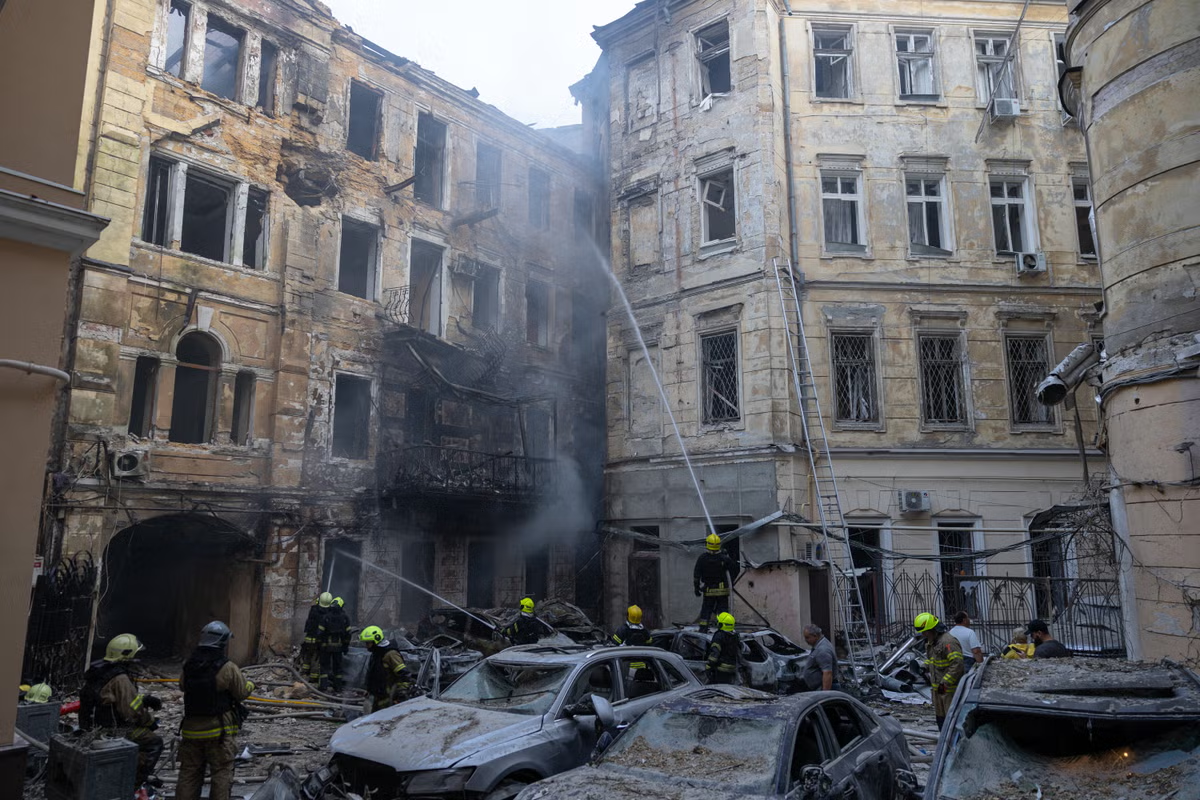
A Russian strike on August 7, 2026, destroyed a World Health Organization (WHO) warehouse in Dnipro, Ukraine, wiping out critical medical supplies bound for the front line. WHO Director-General Tedros Adhanom Ghebreyesus confirmed the loss of over 170 pallets of humanitarian aid, sparking international condemnation of attacks on healthcare.
The strike hit the facility in Dnipro, Ukraine’s fourth-largest city, during a period of intensified Russian aerial campaigns. While UN staff managed to evacuate 130 of roughly 300 pallets of aid before the impact, more than half of the warehouse’s contents were destroyed, according to the WHO.
The Director-General added that without such protections, people are deprived of lifesaving healthcare
and emphasized that even wars have rules
, one of which is the protection of health services.
Front-Line Medical Shortages and “Cynical” Targeting
Dmytro Lubinets, Ukraine’s Ombudsman, described the event as a cynical
attack on the most vulnerable, noting that the strike targeted essential medicines intended for hospitals closest to the fighting.
Lubinets stated on Telegram that he sees a clear and cynical goal of the Russians — to deprive people of the means to save lives
.
This event follows a pattern of strikes on humanitarian actors. In May 2026, a UN convoy delivering supplies to civilians in the Kherson Oblast was severely damaged by two Russian drone strikes. The WHO has also documented an increase in the risks faced by health transport personnel and ambulance drivers throughout the conflict.
Diplomatic Friction Over UN Attribution
An EU diplomat told the Kyiv Independent that officials in Brussels have questioned the UN’s tendency to use the passive voice when condemning strikes, noting that the WHO Director-General did not call out Russia by name in his initial condemnation.

This cautious phrasing is a broader trend across UN social media accounts, though some shifts are appearing. The UN’s Office for the Coordination of Humanitarian Affairs did call out Russia for attacking civilian targets on July 30.
Further tensions emerged over a separate Unicef statement. Ukrainian Foreign Minister Andrii Sybiha criticized the agency for failing to explicitly name Russia as the aggressor in the deaths of children. Sybiha argued that by presenting casualties without the context of Russia’s war of aggression, Unicef created a false equivalence between the aggressor and the victim
.
Civilian Atrocities and War Crime Investigations
The strike on the WHO warehouse coincides with a surge in civilian casualties across multiple regions. On July 30, a massive attack involving more than 70 missiles and 280 drones hit the village of Radushne near Kryvyi Rih. The strike destroyed the home of the Voronov family; of the 10 family members present, five deaths were confirmed, including three children aged 6, 11, and 17.

- Kyiv: A missile attack killed at least 17 people, which some viewed as retaliation for Ukrainian strikes on the e-commerce giant Wildberries.
- Sumy: Glide bombs killed five people and injured 30 in a crowded area.
- Kharkiv: Russian strikes in Balakliya killed three people, including two women and one man.
- Odesa: A Russian attack on a Guinea-Bissau flagged ship, the Mera Queen, killed one crew member.
The scale of these incidents has led to a massive legal effort to document atrocities. According to a European Commission webpage updated in May 2026, Ukraine is investigating more than 200,000 incidents of alleged international crimes, with suspicions that the actual number is higher.
Ukrainian Counter-Strikes on Russian Infrastructure
As Russia targets medical and civilian hubs, Ukraine has shifted its focus toward Russian energy and logistics.
Ukraine has also targeted the logistics network of Wildberries, Russia’s largest e-commerce retailer. Kyiv alleges the company supplies dual-use items for military purposes. Since July 18, at least 20 Wildberries warehouses have been attacked.
The conflict continues to expand in scope, with Zelenskyy claiming that North Korea is preparing to deploy as many as 50,000 soldiers to support Russia. In response, Ukraine has appealed to South Korea for increased air defense systems to protect its remaining civilian and medical infrastructure.
Продолжение темы