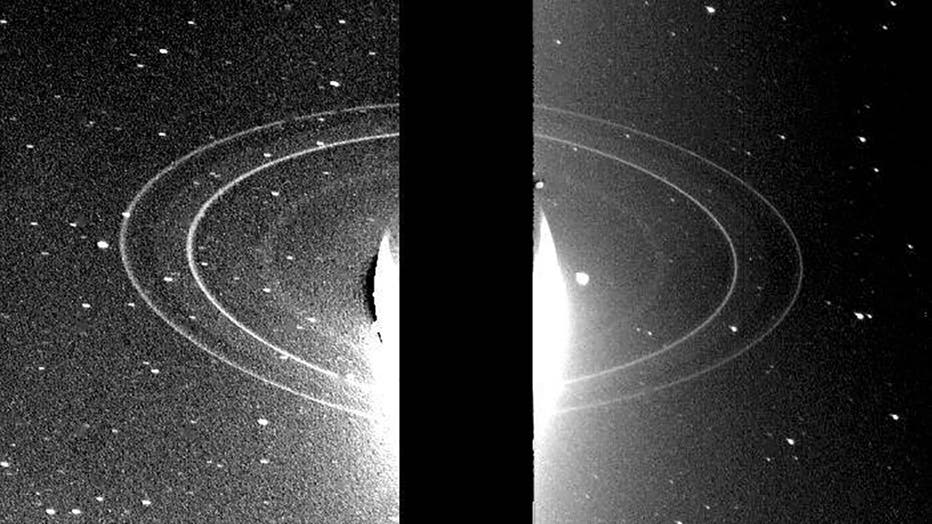
Researchers using the James Webb Space Telescope have detected magnesium-rich clay minerals on Neptune’s rings and three inner moons—Larissa, Galatea, and Proteus.
The discovery of phyllosilicates—water-altered clay minerals—on the inner satellites of Neptune provides the first concrete evidence of a catastrophic restructuring of the planet’s early environment. According to a study led by Ryleigh Davis, a postdoctoral researcher at UC San Diego and former Caltech graduate student, these minerals are unique among outer solar system bodies beyond Jupiter.
Magnesium-rich clays on Larissa, Galatea, and Proteus
Using the near-infrared spectrograph on the James Webb Space Telescope (JWST), the research team analyzed the chemical makeup of Neptune’s rings and three of its smallest inner moons: Larissa, Galatea, and Proteus. The data revealed the presence of magnesium-rich phyllosilicates, minerals that only form when rock interacts with liquid water.
The presence of these clays is contradictory to the current state of the moons. While the minerals require liquid water to form, the JWST spectra showed no evidence of water ice on the three moons or within the rings themselves. This absence of ice in a region of the solar system typically dominated by frozen volatiles suggests the materials were not formed in situ.
The research team suggests that these minerals likely formed in the interior of primordial satellites that were destroyed during Triton’s violent capture or a tidally shredded dwarf planet.
Because the inner moons are too small to have generated the internal heat necessary to melt ice and create these minerals, the team concluded the clays must be remnants of much larger, differentiated parent bodies that were shattered long ago.
The Triton capture and the destruction of the original system
The research points to a violent evolutionary history that distinguishes Neptune from other planets in the solar system. Most planets possess a “typical” moon system of large, ordered satellites; Neptune does not. The team proposes that Neptune originally had a system of icy moons similar to those currently orbiting Uranus, but this system was demolished when the planet captured Triton.

Triton, Neptune’s largest moon, likely formed elsewhere in the solar system before being pulled in by Neptune’s gravity. The resulting gravitational upheaval is believed to have cleared out the original satellite system, leaving behind a cloud of debris. Over time, the wreckage from this smashup re-accreted to form the tiny inner moons and rings observed today.
The researchers state that their findings suggest the present-day inner moons and rings reaccreted from this deep interior material, thereby providing unique access to the interior composition of icy outer solar system differentiated bodies.
Nereid as the sole surviving satellite
While the inner moons are viewed as recycled rubble, other evidence suggests not every original moon was destroyed.

The presence of phyllosilicates serves as a chemical marker, confirming that the original moons were large enough to undergo internal heating and aqueous alteration before their destruction.
По теме

