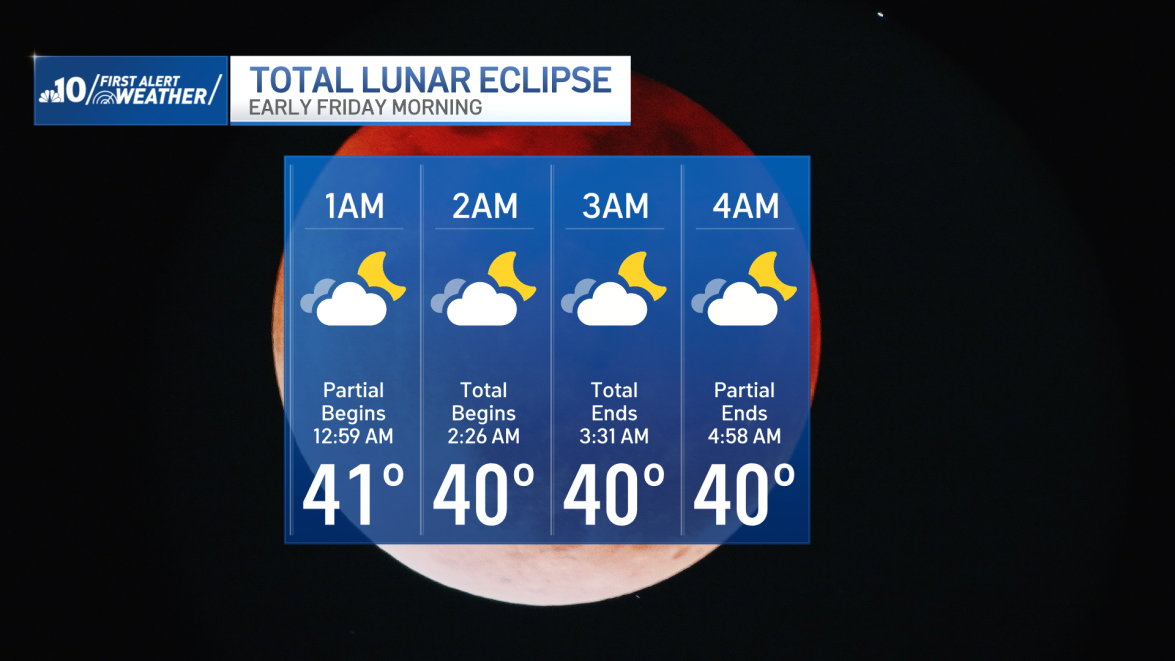
The celestial alignment begins at 10:33 p.m. and peaks at 12:12 a.m., offering a vivid display if visibility holds.
Western Pennsylvania Forecast Threatens Pittsburgh Lunar Viewing
Stargazers across the region are preparing for a striking celestial alignment tonight as the Earth moves directly between the sun and the moon, casting a deep shadow over the lunar surface. Eclipses, which used to be thought of as magic or even witchcraft, depending on what suited them at the moment, are now understood to be just a function of the Earth’s alignment with the sun and moon. Through math, we know that if you are in Pittsburgh, tonight’s partial lunar eclipse will be pretty close to full, with around 96% of the moon turning a reddish hue. A partial eclipse occurs when the Earth forms a line with the sun on one side and the moon on the other side. When the total portion of the moon is 92% or more covered, you get what we are expecting tonight, which is a “blood moon.” In the past, blood moons have played a part in things like the destruction of the Athenian dynasty, the salvation of Christopher Columbus from starvation, and the confirmation of Einstein’s Big Theory, according to History.com.
Weather conditions may dictate whether residents actually catch the sight. If so, it looks like the weather is going to cooperate, with partly cloudy skies in place tonight. Viewers hoping to catch the display are advised to get as far away from bright lights as possible and give your eyes a few minutes to adjust to the darkness.
Exact Timings for Tonight’s Peak and Viewing Recommendations
The celestial progression follows a strict schedule across local time zones. The eclipse begins at 10:33 p.m. and ends at 1:51 a.m. The eclipse peaks at 12:12 a.m. Because the moon will be high in the sky, so you won’t need any help finding it, though optimal photography relies on simple camera adjustments.
If you want to take pictures, make sure your phone is in night mode. Most phones will automatically switch over to take the picture. Besides that, just enjoy! If you miss tonight’s partial lunar eclipse, no worries. We will have two penumbral lunar eclipses occurring next year, with the first happening on Feb. 20th. Our next partial lunar eclipse happens on Jan. 12, 2028, but the coverage will only be around 5%. There will also be a partial solar eclipse in 2028. Interestingly enough, 2029 is going to be fairly active, with a nearly 50% partial solar eclipse coming in January and two total lunar eclipses occurring, with the first happening on June 26, 2029. Credit for these Pittsburgh dates goes to timeanddate.com.
Astronomical Perspectives on Celestial Scarcity and Modern Skies
Shanti Mathias makes a passionate argument for staying up late, going outside and marvelling at the red moon. Most media outlets promote a scarcity mindset when it comes to celestial phenomena, framing them as events that hardly ever occur. The line for this eclipse is that this exact arrangement of sun, Earth and full moon won’t be visible again until 2028. Victoria University of Wellington senior lecturer and astrophysicist Yvette Perrott can see the problem. If you talk about things being rare and special all the time, they might stop seeming so rare and special,
the Victoria University of Wellington senior lecturer says.
Perrott emphasizes that direct, unassisted observation remains valuable even in an era of advanced space telescopes. It’s special to see things with your eyes, even if you can see photos online from the Hubble Space Telescope that are a thousand times better,
Perrott says. Unlike chemistry or engineering, astronomers can’t go into a lab to see what happens. It is only possible to study what it is possible to see. We are passive observers, we take the chances we’re given,
Perrott says. All that sunlight streaming through the precious atmosphere which keeps us alive will refract onto the moon, but just in the red and yellow wavelengths, which will turn the moon red.
Beyond immediate weather concerns, researchers continue to voice caution regarding the long-term clarity of the night sky. Perrott and other astronomers are worried that the current rate of satellite launches could make it harder to access the night sky. A SpaceX proposal for a million satellites to host data centres in space would make the sky lighter, wherever you are.
Ещё по этой теме

