
NASA’s Nancy Grace Roman Space Telescope is scheduled to launch on a SpaceX Falcon Heavy rocket on Sunday, August 30, 2026, from Launch Complex 39A at the Kennedy Space Center in Florida, opening a five-year mission to map the Milky Way and investigate dark energy.
Launch Schedule and Falcon Heavy Flight Profile from Kennedy Space Center
SpaceX is targeting liftoff for no earlier than 7:26 a.m. EDT on Sunday, August 30, 2026, with a backup window available at 7:22 a.m. EDT on Monday, August 31, if weather conditions interfere. The National Weather Service reported a 50% chance of thunderstorms at Kennedy Space Center ahead of Sunday morning. A live webcast hosted by NASA is scheduled to begin at 6:20 a.m. EDT, spanning the launch sequence and a post-launch press briefing scheduled for 9:30 a.m. EDT.
“Following stage separation, Falcon Heavy’s two side boosters will land on SpaceX’s Landing Zones 2 and 40 (LZ-2 and LZ-40) at Cape Canaveral Space Force Station in Florida.”
SpaceX mission overview
The total flight duration from liftoff to spacecraft deployment is timed for 31 minutes and 31 seconds. Following separation from the rocket’s second stage, the observatory will journey to its permanent operational station at the Sun-Earth L2 Lagrange point, located roughly 1 million miles from Earth.
Origins From a Surveillance Satellite and Unprecedented Survey Speeds
The observatory’s path to space began roughly 15 years ago when NASA planned a mission to hunt for Type 1A supernovas to measure the accelerating expansion of the universe driven by dark energy—a discovery that won a Nobel Prize in 2011. During development, The National Reconnaissance Office reached out to NASA, offering an unused surveillance satellite sitting in a hangar.
Duke University cosmologist Daniel Scolnic noted that the surveillance hardware was redirected upward rather than downward, undergoing substantial modifications to become a civilian observatory. Scolnic added that the telescope will test existing cosmological models, stating that in the last few years, there have been measurements saying that model might be wrong — and that’s something that Roman will absolutely nail, whether the model’s right or wrong
.

While sharing comparable sensitivity and optical sharpness with the Hubble Space Telescope, Roman’s architectural design allows for sweeping panoramic sweeps. Project scientist Julie McEnery explained that that one month of observations to survey our Milky Way galaxy would take about a century with Hubble. Furthermore, mission planners intend to make collected catalogs accessible to academic institutions and classrooms alike, ensuring that you can be a teacher in a high school in Kentucky and your students have the opportunity to see Roman data at the same time as a professor in Princeton
.
Exoplanet Hunting via Gravitational Microlensing and the Wide Field Instrument
Researchers also plan to utilize gravitational microlensing—a technique first described theoretically by Albert Einstein in 1936—to detect worlds that remain invisible to traditional transit methods.
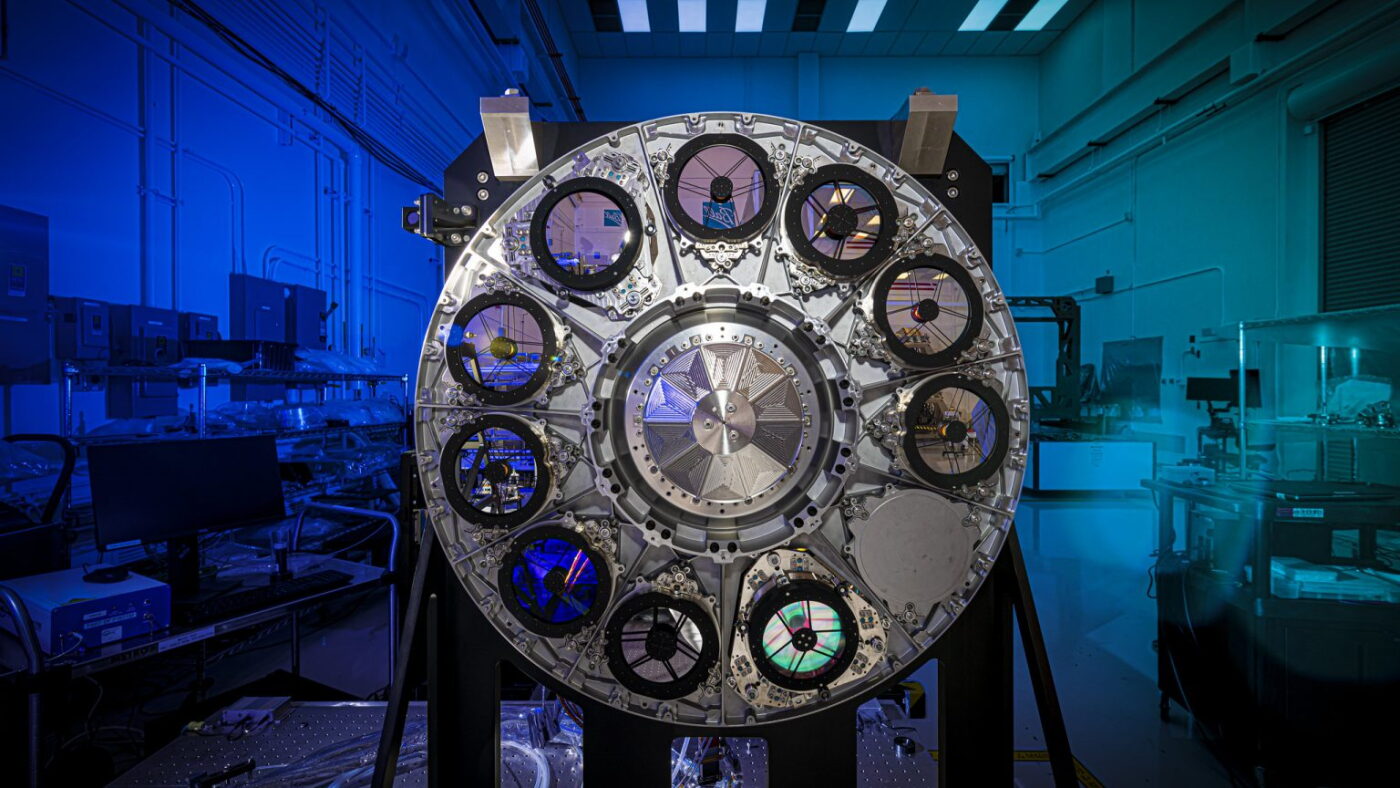
Scott Gauti of The Ohio State University emphasized the scope of the search, stating that we’re looking for planets that are just completely undetectable by any other method, pointing specifically to distant bodies near the galactic center that are very analogous to our own solar system planets like Jupiter, Saturn, Uranus, and Neptune
.
The telescope’s wide field of view—measuring 100 times that of Hubble—will greatly increase the number of galaxies with precisely clocked speeds, helping researchers address persistent cosmological discrepancies such as the Hubble tension and sigma-eight clumping metrics.
Mission Timeline and Post-Launch Leadership Briefing
Following separation, engineers will spend months calibrating the observatory’s systems before releasing initial operational imagery. The baseline mission span is set for five years, though project participants anticipate a potential lifespan lasting twice as long or more.
A post-launch news conference scheduled for 9:30 a.m. EDT on Sunday will feature NASA Administrator Jared Isaacman; Nicky Fox, associate administrator, Science Mission Directorate, NASA Headquarters; Jackie Townsend, Roman telescope project manager, NASA Goddard; Julie McEnery, Roman telescope senior project scientist, NASA Goddard; and Denton Gibson, launch director, NASA’s Launch Services Program, NASA Kennedy.
По теме

