U.S. stocks rallied on Thursday, as Treasury yields retreated from multi-year highs following dovish comments from Federal Reserve Governor Chris Waller. Waller signaled support for keeping interest rates unchanged later this month, prompting investors to scale back rate-hike expectations and driving the Dow up as much as 600 points.
Investors caught a break on Thursday as the bond market found its footing after a steep global sell-off earlier in the week. U.S. Treasury yields pulled back sharply from multi-year highs, reversing some of the damage from a Tuesday rout that had sent borrowing costs surging across global debt markets according to Business Insider.
The sudden shift in market sentiment came directly from policymakers. Federal Reserve Governor Chris Waller delivered remarks that traders and analysts quickly interpreted as a signal to pause further monetary tightening at the central bank’s upcoming meeting.
Federal Reserve Signals and the Shift in Market Expectations
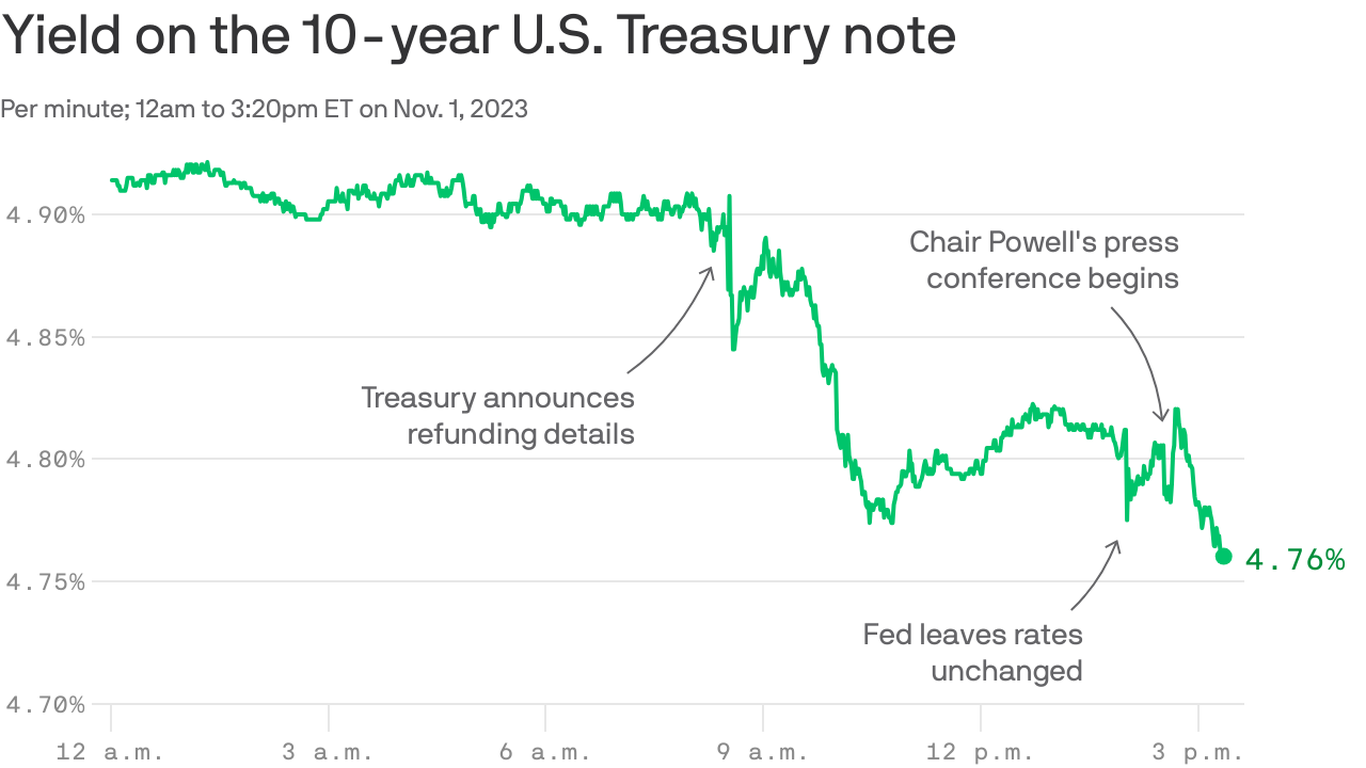
The bond market’s reaction was immediate. The 2-year U.S. Treasury yield, which tracks Federal Reserve policy expectations most closely, slid 5 basis points to 4.33%. The 10-year Treasury yield pulled back 4 basis points to 4.75%, retreating from a peak of 4.81% on Wednesday—the highest level recorded since 2023 as reported by Business Insider.

Waller added that he saw little urgency to adjust borrowing costs while economic growth remains solid, the labor market stays in satisfactory shape, and disinflation continues to progress.
Major financial institutions confirmed the dovish interpretation of the speech. Economists at Goldman Sachs noted that The bond market read Waller’s speech as dovish,
adding that the bank expects the Fed to remain on hold regarding interest rates according to Business Insider. Gregory Daco, the chief economist at EY, wrote in a note that Waller’s remarks point to a Fed hold at the September FOMC meeting, contingent on continued disinflation, while issuing a clear warning that a hot August consumer price index print would reopen the door to further tightening.
Wall Street Rally and the Cooling Oil Market
With rate-hike fears receding, traders rushed back into risk assets. Expectations for an interest rate hike at the September meeting plummeted, with investors driving down the implied probability to about 50%, down from 63% on Wednesday according to the CME FedWatch tool cited by Business Insider.
Equities surged on the recalibrated outlook. The Dow Jones Industrial Average advanced as much as 600 points, putting it on pace for its best single-day performance in a month. Both the S&P 500 and the Nasdaq 100 gained more than 1% as investors scooped up shares as detailed by Business Insider. In separate comments, New York Fed President John Williams described recent inflation data as encouraging and attributed the recent spike in yields to the underlying strength of the broader economy.
At the same time, upward pressure on energy markets showed signs of easing. International benchmark Brent crude had previously climbed toward the critical $100-a-barrel mark amid an ongoing war involving Iran as reported by Business Insider. On Thursday, Brent crude rose about 1% to trade around $96 a barrel before paring its gains, effectively cooling a rally that had threatened to complicate the Federal Reserve’s inflation fight.
Upcoming Economic Data and Market Risks
Despite Thursday’s reprieve, market participants remain cautious as they look toward a heavy economic calendar. Earlier in the week, renewed hostilities in the Middle East drove Brent crude above $90 a barrel and pushed U.S. crude higher following strikes on Iranian rocket launchers near the Strait of Hormuz, reminding investors how quickly geopolitical shocks can alter market direction as noted in market updates from Cryptorank.
Analysts point out that August brought solid gains for major U.S. benchmarks—with the Dow up about 2.1%, the S&P 500 up roughly 3%, and the Nasdaq gaining about 4.1% for the month according to Cryptorank. However, historical seasonal patterns often present headwinds for the S&P 500 heading from mid-August through early October.
Wall Street’s immediate focus turns to the upcoming employment report and consumer price index figures. These reports will serve as the definitive test of whether disinflation is progressing enough to lock in a Federal Reserve pause or if stubborn inflation and energy costs will force policymakers to reconsider.
Ещё по этой теме