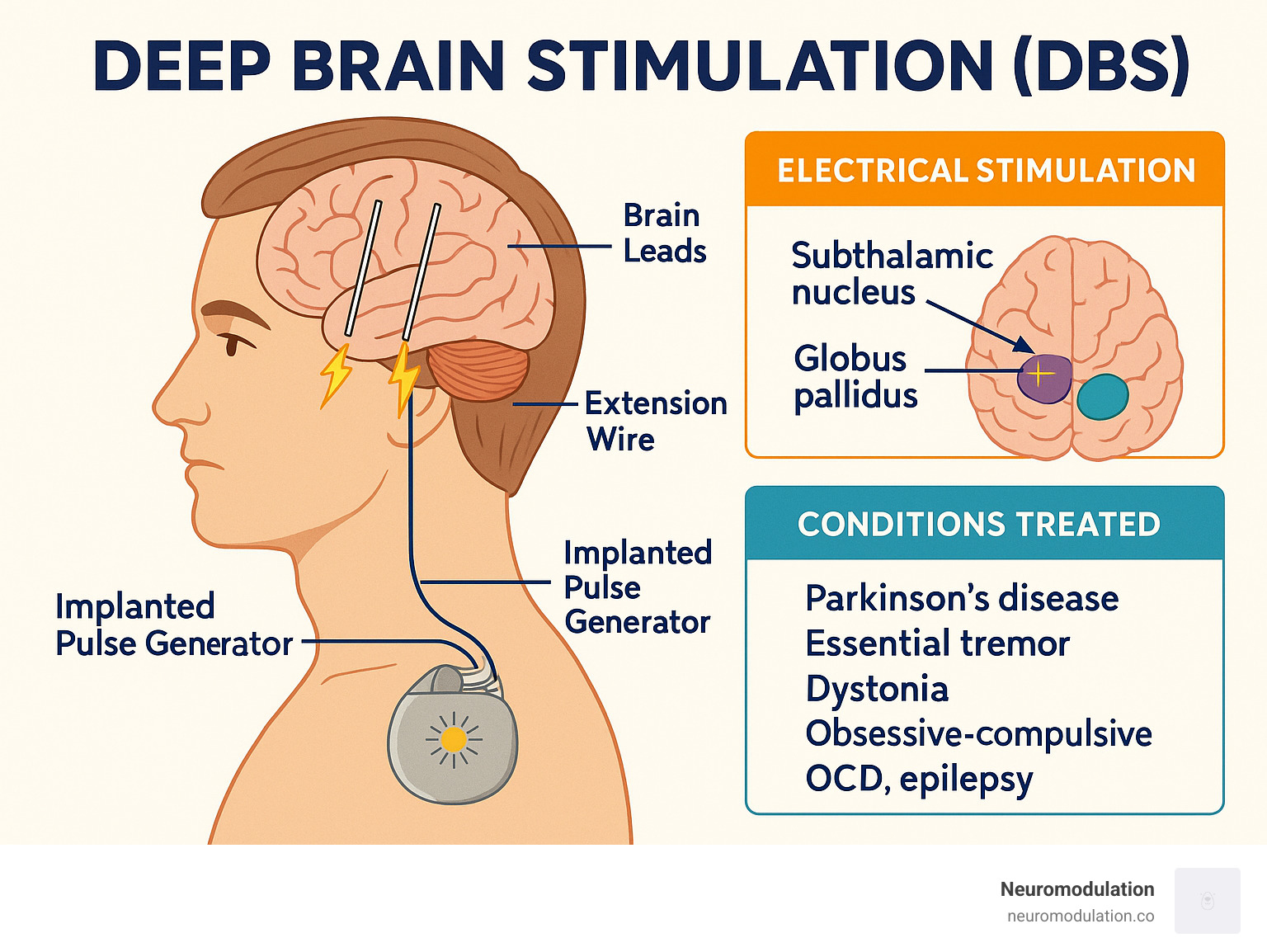
Researchers at institutions including Weill Cornell Medicine and Stanford University report that experimental deep brain stimulation of the thalamus significantly improved executive function in five patients suffering from chronic cognitive deficits years after moderate to severe traumatic brain injuries.
A phase 1 clinical trial reported Dec. 4 in Nature Medicine has challenged long-standing medical assumptions regarding traumatic brain injuries, suggesting that persistent cognitive impairment may stem from disrupted neural communication rather than irreversible cell death. The research, led by investigators across several major medical centers including Weill Cornell Medicine, Stanford University, the Cleveland Clinic, Harvard Medical School, and the University of Utah, evaluated five patients living with chronic deficits years after their initial trauma.
Targeting the Central Thalamus to Overdrive Brain Function
The study utilized deep brain stimulation, a technique in which a battery-powered device is implanted under a patient’s skin, with electrodes extending from the device to a part of the thalamus that routes signals from one section of the brain to another. This central brain region acts as an energy regulator and primary relay station. Dr. Nicholas Schiff, the Jerold B. Katz Professor of Neurology and Neuroscience in the Feil Family Brain and Mind Research Institute at Weill Cornell Medicine, described the approach by noting, Basically, our idea has been to overdrive this part of the thalamus to restore brain function, much as a cardiac pacemaker works to restore heart function.
Recent estimates by the Centers for Disease Control & Prevention suggest that in the United States alone, TBI accounts for more than 200,000 hospitalizations and more than 60,000 deaths annually, with roughly five million Americans suffering from long-term, TBI-related cognitive disability. Traditionally, both the medical community and the public viewed moderate to severe traumatic brain injuries as permanently disabling due to assumed brain-cell loss. However, researchers tested an alternate theory: that injuries often disrupt signaling between undamaged regions. By applying electrical stimulation for 12 hours a day, the team aimed to reawaken quiescent circuitry and upregulate viable downstream parts of the brain.
Substantial Gains Documented in Clinical Trial Participants
Five people who had life-altering, seemingly irreversible cognitive deficits following moderate to severe traumatic brain injuries completed the experimental protocol after sustaining injuries from motor vehicle accidents or falls — including one from 450 feet and another from roughly 60 feet — between three and 18 years prior to the trial. While each participant had previously recovered enough to perform the activities of daily living such as personal hygiene, dressing, and feeding themselves, cognitive deficits involving memory, attention, and executive function prevented them from returning to pre-injury levels of work, study, or social engagement.
To measure efficacy, investigators utilized a standard test of executive function called the trail making test part B
and established 10 percent improvement as a clinically relevant threshold. By the study’s end, all five patients had exceeded the 10 percent threshold, producing an average improvement of 31.75 percent.
| Metric | Trial Finding |
| Treatment Duration | 12 hours daily for three months |
| Targeted Brain Region | Central thalamus |
| Individual Improvements | Ranges from 15 percent to 55 percent |
| Average Improvement | 31.75 percent across participants |
The greatest gains, more than 40 percent, were seen in the two who had suffered falls and had the deepest initial deficits. Even those with mild impairment improved by more than 20 percent. Furthermore, two participants, one injured in a car accident and a second hit by a car while riding a bicycle, regained the ability to work, albeit at reduced capacity, and socialize. Several of the participants and their family members reported substantial quality of life gains, including improvements in the ability to work and to participate in social activities, according to a report describing participant and family perspectives from the trial led by Dr. Joseph Fins, the E. William Davis, Jr., MD Professor of Medical Ethics at Weill Cornell Medicine. One participant said in the report: The ability to keep your focus and ignore the other things that aren’t important to focus on is very, very important to a lot of things in life. You never know what a blessing it is until you get it the second time.
One mother called her daughter’s improvement “profound” and “a miracle.”
Challenging Brain Injury Nihilism and Moving Forward
The findings offer a stark contrast to historical expectations that recovery plateaus entirely within the immediate post-injury phase. Joseph Giacino, Spaulding’s director of rehabilitation neuropsychology and a professor of physical medicine and rehabilitation at Harvard Medical School, who helped design the study, noted the shift away from what is described as permanent disability.

“If the thalamus — this key relay station and signaling system — is damaged, it can’t activate or upregulate those circuits that are relatively spared and could work and perform their role if they had the right input.”
Joseph Giacino, Spaulding Rehabilitation Hospital and Harvard Medical School
Dr. Jaimie Henderson, the John and Jene Blume – Robert and Ruth Halperin Professor in the Department of Neurosurgery at Stanford University School of Medicine and study co-senior author, stated, Our aim now is to expand this trial, to confirm the effectiveness of our DBS technique, and to see how broadly it can be applied to TBI patients with chronic cognitive deficits.
Читайте также

