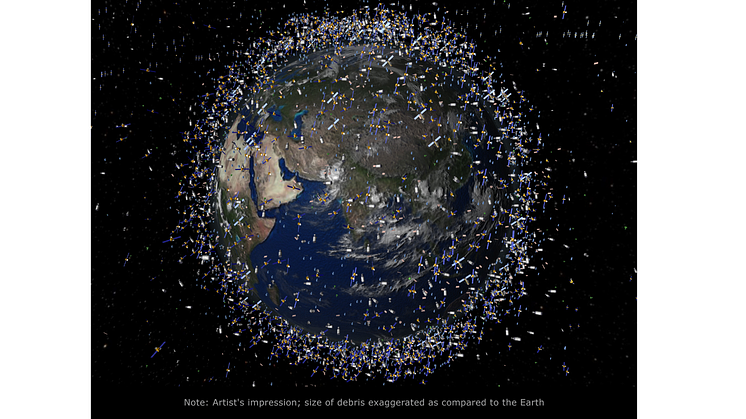
Earth’s orbital environment faces escalating congestion as commercial satellite constellations expand rapidly and national space programs grow. According to the European Space Agency’s 2026 report, over three intact spacecraft re-enter the atmosphere daily while roughly ten new payloads launch, driving up collision risks and atmospheric debris threats.
Low Earth orbit is turning into a crowded highway. As commercial operators and national space agencies launch thousands of spacecraft, the physical limits of near-Earth space are colliding with commercial ambition. The situation has pushed orbital traffic management to the forefront of international space policy.
SpaceX has placed 10,000 satellites in orbit and outlined a long-term plan to launch 10,000 communications satellites annually, according to international media reports.
Federal Communications Commission Approvals and Starlink Operations
The regulatory framework governing this expansion is shifting quickly. In January, the Federal Communications Commission authorized SpaceX to deploy an additional 7,500 second-generation Starlink satellites. That approval brought the company’s total authorized fleet to 15,000 spacecraft, though the agency deferred review for roughly 30,000 originally requested.
This dominant footprint creates operational hurdles on a daily basis. Starlink spacecraft performed more than 355,000 collision-avoidance maneuvers between June of last year and May of this year, based on filings with federal regulators. That volume translates to more than 40 adjustments per satellite annually.
SpaceX applies a conservative collision-risk threshold compared to industry norms, meaning not every maneuver reflects an imminent near-miss. Even so, the sheer frequency highlights the density of the orbital highway.
European Space Agency Space Environment Report 2026 Findings
The European Space Agency published its Space Environment Report 2026, drawing on data collected through the end of 2025. Produced by the agency’s Space Debris Office, the document provides an annual overview of global space activity and evaluates whether debris-mitigation measures are protecting the long-term sustainability of spaceflight.
The findings indicate that compliance remains uneven. Not enough satellites are departing heavily congested orbits when their operational lives end, a trend that directly elevates collision hazards. On average, more than three intact satellites or rocket bodies re-enter the atmosphere every day, while roughly ten new payloads are launched.
To capture these risks, the agency introduced a new metric focused on the on-ground casualty risk of re-entries. While the absolute probability remains low relative to daily hazards, it has ticked upward alongside traffic volume.
Global Constellations, Military Rivalries, and the Kessler Syndrome Threat
Amazon has applied to build a constellation of up to 5,105 satellites designed to communicate directly with mobile phones. Meanwhile, China is pursuing rival networks including Qianfan and Guowang, each planned to exceed 10,000 satellites.
Military ambitions are compounding the congestion. The United States and China are developing maneuverable satellites, spaceplanes, and jamming equipment. A recent joint operation by the United States and Britain involved orbiting a satellite believed to be a Chinese reconnaissance craft, demonstrating allied capabilities in contested orbits.

Uncontrolled fragmentation events continue to add risk. LeoLabs reported that the upper stage of a Chinese Long March 6C rocket broke apart at an altitude of roughly 400 kilometers, generating hundreds of fragments that require active monitoring by nearby spacecraft.
When combined, global constellation plans submitted to governments exceed 1.7 million satellites. While not all proposals will launch, researchers from the European Southern Observatory warn that deploying even a fraction of them would profoundly alter the space environment and disrupt ground-based astronomy.
The ultimate fear remains the Kessler syndrome, where a catastrophic collision triggers a cascading chain reaction of debris generation. According to the European Space Agency, active debris removal will eventually be required to halt this self-sustaining cycle of orbital clutter.
Ещё по этой теме
