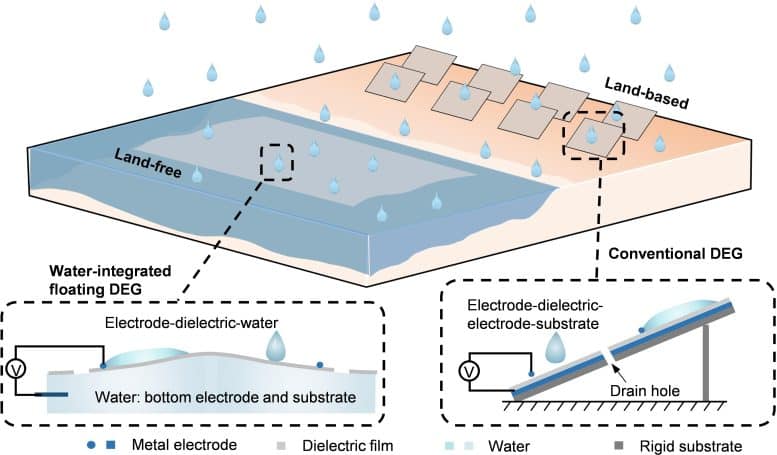
Tested successfully on Lake Donghua, the lightweight device cuts production costs by half and weight by 87 percent compared to traditional hydrovoltaic systems, generating nearly 250 volts per droplet.
Scientists have long sought ways to capture the kinetic energy of rain, but heavy, expensive land-based equipment has historically limited practical use. A team at the NUAA developed a floating droplet-based electricity generator, known as a W-DEG, that floats directly on bodies of water. Instead of relying on rigid frames and bulky metal electrodes, the system uses water itself as a structural and electrical component.
How the W-DEG Converts Rain Into Power on Lake Donghua
The innovation centers on a thin dielectric polymer film placed directly on the surface of a lake or basin. When falling raindrops strike this floating film, the underlying water absorbs the impact thanks to its natural incompressibility and surface tension, allowing the droplets to spread rapidly.
Ions naturally present in the water act as charge carriers, transforming the liquid layer into a reliable conductive electrode. According to researchers detailed in the National Science Review, each individual droplet impact can generate voltage peaks approaching 250 volts, rivaling the performance of far more complex conventional generators.
Weighing the Floating Generator Against Traditional Hydrovoltaic Systems
Traditional hydrovoltaic systems require heavy land-based installations that drive up expenses and limit where equipment can be deployed. By utilizing the water surface for support and electrical grounding, the W-DEG module reduces equipment weight to just 0.5 kilograms per square meter.

Scientists confirm that this design yields an 87 percent weight reduction and a 50 percent drop in production costs compared to standard C-DEG setups. Wanlin Guo, one of the authors of the study, described the breakthrough as a new strategy of generation d’électricité par gouttelettes, légère, rentable et scalable during discussions surrounding the study’s findings.
Managing Heavy Downpours and Environmental Stress
To ensure the system survives torrential downpours without sinking or losing performance, the research team engineered tiny drainage holes into the polymer film. Leveraging fluid dynamics, these micro-holes allow rainwater to drain downward while preventing lake water from bubbling up through the surface.
Laboratory and field tests demonstrated that the W-DEG operates reliably across extreme temperatures, high salinity levels, and environments prone to biological fouling. A prototype covering just 0.3 square meters successfully powered 50 LED lights simultaneously and charged electronic capacitors within minutes during trials.
Future Deployments and Energy Integration
Researchers envision deploying these modular units across natural lakes, reservoirs, and coastal waters to establish decentralized mini-power stations. Rather than replacing wind or solar infrastructure, the technology is designed to complement existing clean energy sources in rainy or remote regions without consuming valuable land.

Open questions remain regarding how well the film integrity holds up against persistent wave action and variable droplet sizing over extended periods. For now, the successful tests on Lake Donghua establish a viable blueprint for harvesting energy directly from the sky.
Читайте также

