
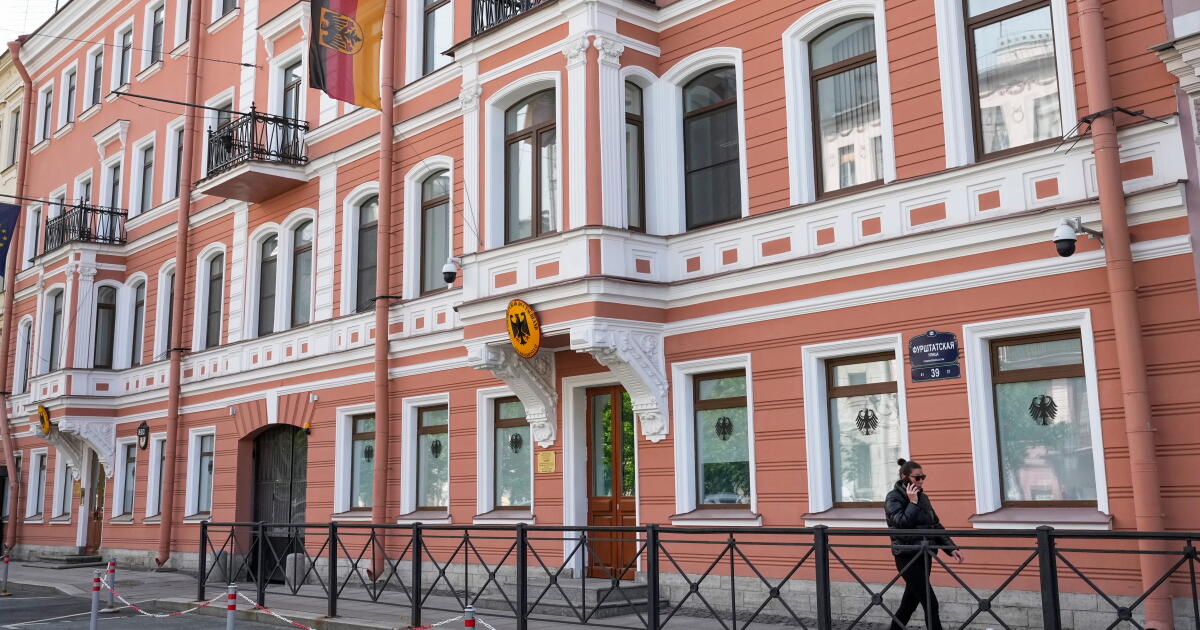
Russia announced the closure of Germany’s consulate in St. Petersburg and ordered Goethe-Institut branches to close by mid-September. The retaliatory diplomatic expulsions follow Germany’s decision to shut a Russian consulate and a cultural center in Berlin over a thwarted drone attack at Leipzig Airport.
Diplomatic relations between Berlin and Moscow plunged further into crisis on Monday, September 7, when the Russian Foreign Ministry announced the closure of the German Consulate General in St. Petersburg. The retaliatory expulsions mark an escalation in tensions triggered by a failed drone attack on aviation and military logistics infrastructure in Germany earlier in August.
St. Petersburg Consulate Ordered Shut by Sept. 18
Under the directive issued in Moscow, the German consulate must cease all operations no later than September 18, and its diplomatic staff must evacuate Russian territory by that date, according to reporting from European Pravda. The measures also target German cultural presence across the country. Moscow reaffirmed its previously scheduled shutdown of the Goethe-Institut branches in Moscow, St. Petersburg, and Yekaterinburg, ordering employees to vacate those facilities.
Russian Foreign Minister Sergey Lavrov had signaled the cultural retaliations days earlier while speaking at the Eastern Economic Forum in Vladivostok, asserting that Berlin should have understood that closing the Russian House would mean the end of its cultural footprint inside Russia.
“It was the German authorities who, once again, provoked a new round of escalation in bilateral relations.”
Russian Foreign Ministry, via DW
The ministry’s formal statement insisted that the German government bears full and complete responsibility for the unfolding consequences. In addition to the consular closure, staff members of the Goethe-Institut faced a departure deadline of Sunday, September 13, dismantling an educational network largely financed by the German government.
The Leipzig Airport Drone Incident and Intelligence Concerns
The diplomatic rupture stems directly from an attempted drone attack at Leipzig/Halle Airport on August 4. Security personnel discovered an explosives-laden drone positioned near a Ukrainian cargo aircraft inside the facility’s secure zone. The drone was defused, but the discovery sent shockwaves through European security circles.
The Leipzig facility functions as an international freight hub and a logistical conduit for providing support to Ukraine. German authorities acted following the incident. On September 1, the German government officially blamed Moscow for the hybrid attack, stating it had employed low-level agents for the operation.
In response, Germany ordered the closure of the Russian consulate in Bonn and terminated the legal agreement governing the Russian House cultural center on Berlin’s Friedrichstrasse. Opened originally in 1984, the seven-story Berlin facility served as the flagship Russian Center for Science and Culture operated by Rossotrudnichestvo.
German investigative reporting revealed that the Bonn consulate was targeted due to its alleged use as a coordination hub for Russian intelligence and hybrid operations across Western Europe. Approximately 60 Russian diplomats, including Consul General Oleg Krasnitsky, were ordered to leave Germany. Intelligence assessments indicated that roughly one-third of the departing personnel maintained affiliations with Russian security services, including the FSB, SVR, and GRU.
Broader European Security and Arrests
The security fallout extended beyond consular expulsions. German law enforcement identified two suspects linked to the Leipzig airport plot: a Belarusian national holding a Russian passport and a Russian-born man possessing Latvian citizenship.
Western governments view the incident as part of a wider campaign of sabotage aimed at disrupting European infrastructure and eroding public support for Ukraine. French Minister for Europe and Foreign Affairs Jean-Noël Barrot condemned the deployment of an explosive drone against German infrastructure as a severe escalation.
During a joint appearance in Brussels, European Commission President Ursula von der Leyen and NATO Secretary General Mark Rutte emphasized alliance unity against ongoing hybrid threats.
“If Russia thinks we will be divided by the threat, or if they think we will be deterred from supporting Ukraine, they are mistaken.”
Mark Rutte, NATO Secretary General
As diplomatic channels narrow, both nations face a September 18 deadline to complete the reciprocal evacuation of consular personnel.
Ещё по этой теме

