Emergency responders in Nepal pulled a Chinese national from a hydropower tunnel and a local woman from her partially submerged home in separate operations, exactly 10 days after devastating floods struck Nepal and Tibet, according to Thejournal.
Rescuers Pull Man From Tunnel and Woman From Half-Submerged Home
The widespread destruction was triggered by a massive glacial and rock collapse on August 26, which sent a tsunami-like wall of water, mud, and debris across the China-Nepal border.
Joint Rescue Operations Underground and in Nuwakot
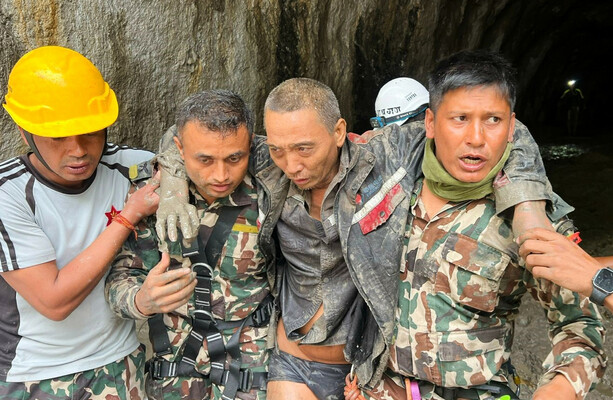
A joint rescue team consisting of Nepal Army personnel and South Korean disaster experts reached the Chinese national, identified as Luhaitao, from 225 metres inside a tunnel of the Upper Trishuli-1 Hydropower Project located in the Rasuwa district, as reported by The Guardian.
Photographs and videos published by the military showed the man appearing alert with his hands covered in thick, wet mud while being evacuated by helicopter. According to nbcnews.com, the man recounted hearing rescue crews and repeatedly shining lights or shouting when he saw their equipment, later stating in audio shared by Chinese state broadcaster CCTV: When they rescued me today, when they shone before my eyes, I couldn’t believe it.
Later on the same day, members of Nepal’s Armed Police Force rescued 64-year-old Chandrika Shrestha alive from her buried house in Nuwakot district while clearing the area, as detailed by Thejournal. Visuals released from the scene depicted only the upper portion of her home visible above thick sludge, while responders gave her bottled water and wrapped her in a blanket before she was airlifted to Kathmandu for medical treatment.
Ongoing Search Efforts and Hydropower Project Impact
The recent successful extractions bring the total to three workers pulled alive from the Trishuli hydropower project area, following the rescue of two Nepali workers—identified as 30-year-old mechanical foreman Sanjay Shah and 45-year-old mechanical supervisor Kabir Maharjan—from a tunnel at the Trishuli 3A plant on Friday, according to dailymail.com.

Authorities note that at least 12 hydropower projects have been destroyed by the disaster, leaving hundreds of workers missing and an estimated 500 people still believed to be trapped inside blocked underground tunnels and infrastructure. International specialized response teams from nations including India, China, South Korea, and the United States have deployed to assist local military engineers in navigating the debris. Rescuers have utilized earth-moving equipment, nighttime digging operations, pipes to supply air into small openings, and drones to deliver medicine, food, and supplies to high-altitude areas cut off by destroyed roads and more than 40 collapsed bridges.
Casualties and Scale of the Humanitarian Crisis
The disaster has resulted in a rising death toll and an immense humanitarian challenge across the region. According to official disaster management figures, at least 1,375 people have been confirmed dead—including 1,344 in Nepal and 31 in China—while more than 5,500 people remain missing, encompassing approximately 5,000 in Nepal and 531 in Tibet.
The United Nations has launched a $50 million appeal to assist more than 84,000 affected individuals, while thousands are currently sheltered in temporary relief camps. Prime Minister Balendra Shah pledged to provide safe accommodation for displaced residents, and local authorities have buried more than 1,000 unclaimed bodies in mass graves after collecting DNA samples due to overflowing morgues.
Продолжение темы