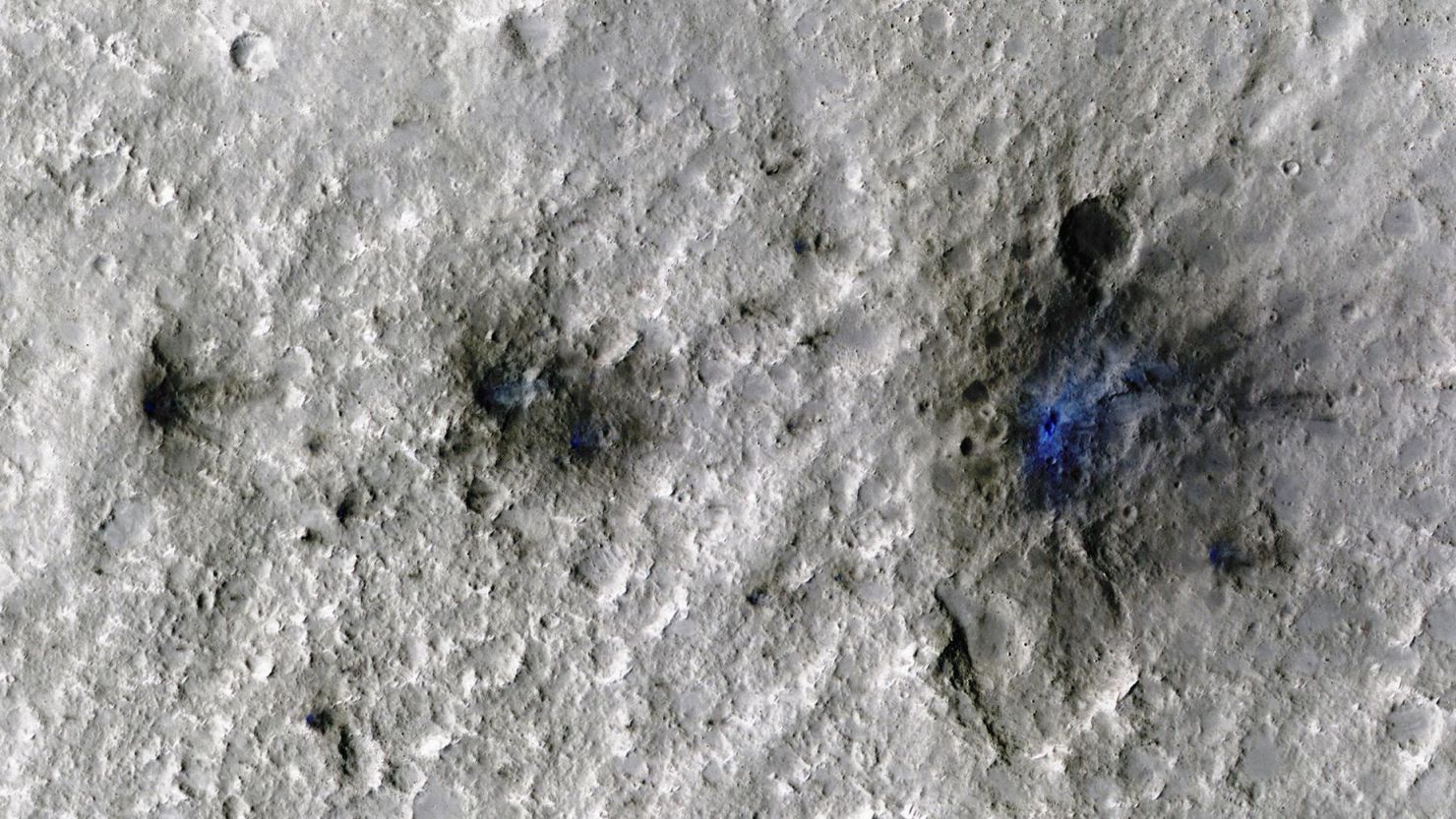
NASA accidentally created five new craters on Mars during the 2020 arrival of the Perseverance rover, according to a study published in Geophysical Research Letters. Tungsten ballast weights and cruise stage fragments struck the Martian surface at approximately 4.7 kilometers per second, providing researchers with an unexpected test of ground mechanics.
When the Mars 2020 mission delivered the Perseverance rover to the red planet, it left behind more than just historical tracks in Jezero Crater. Five accidental impact marks were created when hardware components from the spacecraft struck the terrain, turning discarded mission debris into a novel scientific experiment.
Hardware Impacts Near Jezero Crater
The accidental bombardment began while the spacecraft was still about unos 1.300 km above Mars. To stabilize the vehicle during its interplanetary cruise, the mission released two tungsten ballast devices weighing 77 kilograms each. Fragments from the cruise stage, weighing approximately 540 kilograms, also plummeted toward the surface.
These heavy components slammed into the Martian terrain at a velocity of roughly 4.7 kilometers per second. Researchers spotted the resulting scars using two cameras installed on the Mars Reconnaissance Orbiter. Comparative analysis confirmed that the structures did not appear in images taken before 2020 and displayed distinct reflectivity patterns associated with fresh impacts.
The marks are concentrated approximately 70 kilometers northwest of the Jezero Crater rim. This specific region features ancient valleys that converge toward the delta currently explored by the Perseverance rover.
Uncovering a Much Weaker Martian Soil
Ordinarily, scientists rely on natural meteorite strikes to study planetary geology, but the exact mass, velocity, and composition of natural impacts remain difficult to pin down. The Mars 2020 debris provided a rare advantage because engineers knew the precise physical characteristics of the components involved.

By combining crater dimensions, the distribution of ejected material, and three-dimensional physics simulations, researchers reconstructed the impact dynamics. Calculations indicate that two of the marks resulted from the tungsten ballast devices, while the remaining three originated from cruise stage fragments.
The findings revealed a significant discrepancy when researchers compared the actual craters to standard forecasting models. Standard equations overestimated the resulting crater sizes by up to an order of magnitude, indicating that the local terrain is far less resistant than previously assumed. The components struck the surface at a shallow angle close to 10 degrees.
Simulations and image analysis placed the material’s cohesion at approximately 7 kilopascal units. This low value aligns with a sandy and poorly consolidated terrain, matching earlier observations recorded during excavation difficulties encountered by the InSight mission’s thermal probe.
Planetary Defense and Asteroid Deflection Tests
While Martian debris offers new data on planetary soil mechanics, space agencies continue active preparation against celestial hazards closer to home. The successful DART planetary defense mission demonstrated that kinetic impactors can successfully alter the orbit of an asteroid.

The DART spacecraft targeted the asteroid Dimorphos on September 26, 2022, following a ten-month journey that began with its launch on November 23, 2021. The vending-machine-sized probe slammed directly into the target while transmitting images until the moment of impact.
One always wonders why now. This is the reason why we are testing it now: to be prepared. As the saying goes: better safe than sorry, explained Lucas Paganini, a planetary scientist and program scientist at NASA Headquarters in Washington, D.C., as well as a member of the agency’s Planetary Defense Coordination Office.
Astronomers emphasize that humanity faces zero immediate risk from documented near-Earth objects. Julia de León Cruz, an investigator at the Instituto de Astrofísica de Canarias who has studied the Didymos system for over a decade, noted the current absence of terrestrial threats from classified space rocks.
To send a reassuring message: all objects that we have classified as potentially hazardous have a probability of zero of impacting Earth in the next 100, 150 years, for now. Julia de León Cruz, Instituto de Astrofísica de Canarias
Both the unintended Martian craters and intentional kinetic impactors highlight how spacecraft behavior—whether planned or accidental—continues to refine humanity’s understanding of planetary physics across the solar system.
Продолжение темы

