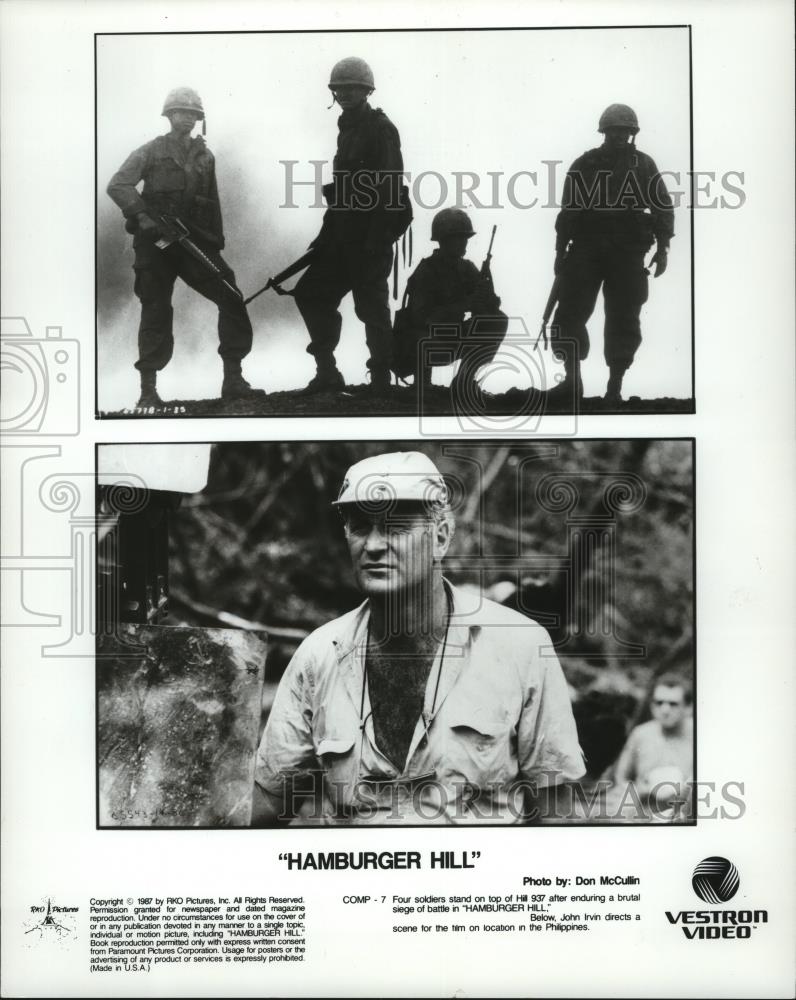
British filmmaker John Irvin, known for directing the Vietnam War drama Hamburger Hill
and the BAFTA-winning television adaptation of Tinker Tailor Soldier Spy,
died Aug. 11 at the U.K. home of his sister-in-law. He was 86. His producers confirmed the death of the versatile director, whose career spanned more than 30 feature films, television, and documentaries.
The career of John Irvin moved easily between gritty war films, Hollywood studio projects, and prestige British television. Born in Wallasey, Cheshire, on May 7, 1940, alongside his twin brother David, Irvin studied at the London Film School in the late 1950s.
Before turning to fiction features, Irvin built a reputation as a documentary maker. He created short films for his own company, Mithras Films, as well as the BBC and ITV. His 1967 short Mafia No!
—focusing on Italian social activist Danilo Dolci—earned a BAFTA Award nomination for Best Short Film, according to Variety.
Documentary Roots, BAFTA Recognition, and MI6 Encounters
Irvin’s documentary work brought him into contact with real-world conflicts and, occasionally, intelligence agencies. While shooting a project on the North Yemen Civil War, Irvin experienced firsthand debriefings that he later recounted in interviews. When I did my documentaries, I would have dealings with the security services from time to time but that was MI6 not MI5,
Irvin recalled.
“When I came back from Yemen, where I shot a documentary on the Civil War I was debriefed. There wasn’t much I could tell them, but I was never part of that world or paid. I was far too left-wing, for a start, but was anti-apartheid, anti-war, anti-nuclear. They were probably well aware of my leftwing activities, so I was certainly not involved in any hanky-panky.”
John Irvin, via Variety
Earlier in his career, his 1963 documentary short Inheritance,
which examined the aftermath of the Algerian War and was narrated by Richard Burton, secured his first BAFTA award, presented by Audrey Hepburn. By the end of the 1960s, Irvin had directed young actors like Edward Fox and Anthony Hopkins, giving Hopkins his first television role in the 1969 production The Peasants Revolt.
Directing Tinker Tailor Soldier Spy and Entering Hollywood
The 1970s marked a transition into prestige television drama. Irvin directed the BBC miniseries adaptation of John le Carré’s Tinker Tailor Soldier Spy,
a project featuring Alec Guinness, Ian Richardson, Patrick Stewart, Beryl Reid, and Michael Jayston. The series earned multiple BAFTA wins and a Primetime Emmy nomination.
Actor Alec Guinness held a strong regard for the director’s working style on set, writing later that he admired a director with balls behind the camera!
Following the success of the le Carré adaptation, Irvin crossed over to American studios, directing Christopher Walken and Tom Berenger in The Dogs of War
(1980).
Box Office Success With Ghost Story and Hamburger Hill
In 1981, Irvin directed the horror film Ghost Story,
starring Fred Astaire, Melvyn Douglas, Douglas Fairbanks Jr., and John Houseman. The supernatural thriller proved to be a commercial success, taking $24 million at the box office and emerging as the third highest-grossing horror film of its release year.
Irvin followed that project with a diverse slate of features, including the biographical film Champions
(1984) starring John Hurt and Turtle Diary
(1985), which was scripted by Harold Pinter and starred Ben Kingsley, Glenda Jackson, and Michael Gambon. In 1986, he directed Arnold Schwarzenegger in the action film Raw Deal.
His most widely recognized critical achievement arrived in 1987 with Hamburger Hill,
a depiction of one of the Vietnam War’s bloodiest battles. Starring Don Cheadle, Dylan McDermott, Michael Boatman, Steven Weber, and Courtney B. Vance, the film was distributed in the United States by Paramount Pictures and cemented Irvin’s reputation for uncompromising combat realism.
A Career of Remarkable Versatility Across Genres
Irvin’s later filmography demonstrated an unusual resistance to being pigeonholed in a single genre. He directed Patrick Swayze in Next of Kin
(1989), Donald Sutherland in Eminent Domain
(1991), Uma Thurman in Robin Hood
(1991), and an ensemble cast including Mia Farrow and Natasha Richardson in Widow’s Peak
(1993).
Writing about Irvin’s eclectic film choices in a 2021 interview, Roel Haanen observed: Not many filmmakers directed both Fred Astaire and Patrick Swayze. Or followed up a tender, thoughtful film written by Harold Pinter with an Arnold Schwarzenegger action flick. But John did …
In the late 1990s, Irvin directed the neo-noir crime thriller City of Industry
starring Harvey Keitel and Stephen Dorff, followed by the HBO war drama When Trumpets Fade
(1998), which served as a forerunner to the network’s later series Band of Brothers.
In his later years, he returned to European independent filmmaking, working on projects including Shiner
with Michael Caine and Mandela’s Gun.
Irvin is survived by his three children—Emilie, Luke, and Amy—and two grandchildren, following the 1991 death of his wife Sophie from cancer. At the time of his death, he was actively working on a new edit of the political thriller Mandela’s Gun.
Продолжение темы

