Industrial design students Andrin Stocker and Luc Schweizer have developed bloc°, an energy-autonomous 3D-printed terracotta brick designed to cool scorching public spaces through evaporation. Presented at the James Dyson Award 2025, the system draws in heat with solar-powered fans and promises temperature drops of up to 9 °C in favorable conditions.
Andrin Stocker and Luc Schweizer
During intense heatwaves, urban environments such as glass-walled bus shelters routinely turn into stifling microclimates where air stagnates and construction materials trap heat long into the night. Concrete poses a particular problem because it continues to radiate heat after sunset, exacerbating discomfort for pedestrians waiting in the open. Seeking a remedy for these unconditioned public zones, Andrin Stocker and Luc Schweizer engineered an alternative cooling method using porous terracotta.
Zurich University of the Arts
The creators of bloc° study industrial design at the Zurich University of the Arts, known as the ZHdK. Their project was submitted to the James Dyson Award 2025 as an intervention for spaces that typically lack air conditioning. The cooling process itself relies on natural evaporation, a physical reaction comparable to how sweat cools human skin.
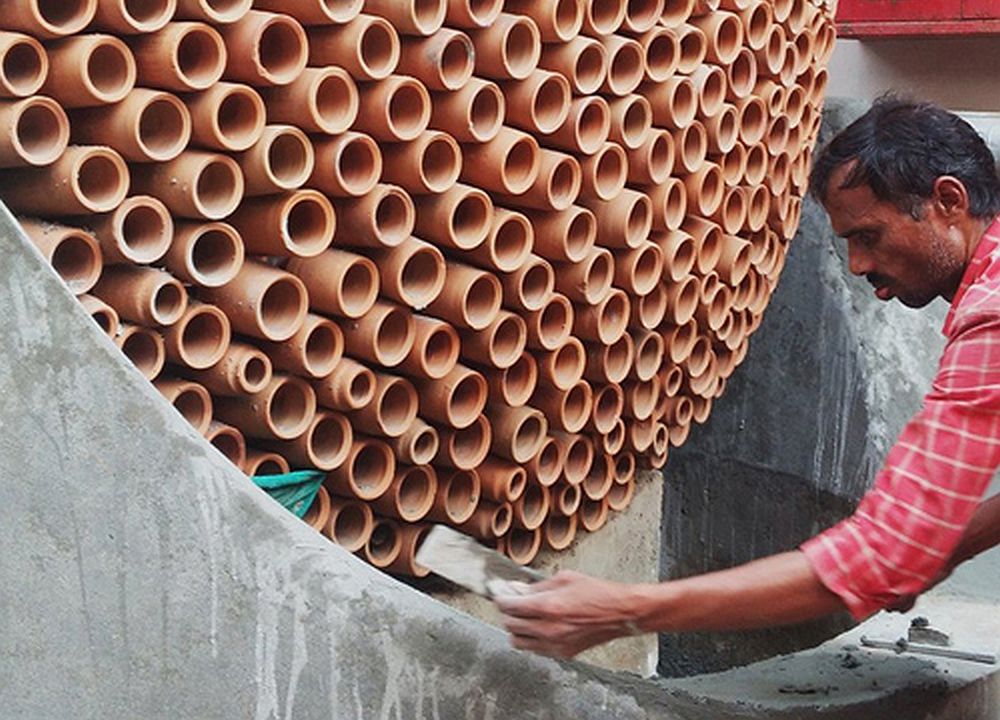
Terracotta is naturally porous, allowing it to absorb water. As warm outside air passes through the material, a portion of that moisture transitions into vapor, drawing thermal energy out of the air in the process. The resulting airflow emerges notably cooler.
While evaporative cooling draws on ancient traditions—ranging from Persian wind catchers and natural cooling jars to termite ventilation—the manufacturing method breaks new ground. 3D printing enables the production of internal chambers inside each brick that traditional molds could never achieve. These intricate internal structures significantly expand the surface area where water and air interact.
Photovoltaic panels
The system operates independently of standard electrical grids. Photovoltaic panels mounted on the units generate electricity for small fans that pull superheated air through the ceramic blocks, alongside a pump that regulates moisture levels across the material. This creates a convenient operational overlap: the system draws the most power precisely when the sun beats down hardest, which is also when cooling output peaks.
Water management presents a distinct logistical hurdle. When ambient temperatures exceed 30 °C, an individual module consumes approximately 56 liters of water per day. A built-in funnel roof captures an average of 24 liters of rainwater daily, which is stored and fed back into the system. During extended dry spells, the deficit requires connection to municipal water lines.
Unlike traditional air conditioners that merely transfer indoor heat directly out onto the pavement—worsening local heat islands—bloc° rejects no hot exhaust into the street. The bricks are modular, allowing them to be stacked and assembled into functional urban furniture such as park benches, low decorative walls, barriers, and abribus backrests. The designers specifically target locations where pedestrians linger stationary under direct sunlight, including bus stops, public squares, pedestrian zones, and school courtyards.
James Dyson Award 2025
Despite its architectural promise, the system faces several recognized constraints. The reported 9 °C temperature drop is a figure calculated by the designers under optimal operational conditions and has not yet been independently verified by outside measurements. The technology remains housed within school workshops as developers prepare a full-scale prototype for real-world testing.

Evaporative cooling relies heavily on dry air. Under high humidity conditions typical of Mediterranean or tropical climates, the efficiency of the ceramic units drops sharply. Production costs, impact resistance against physical damage, graffiti resistance, and potential mineral scaling within the water circuits have not yet been publicly detailed.
Читайте также

