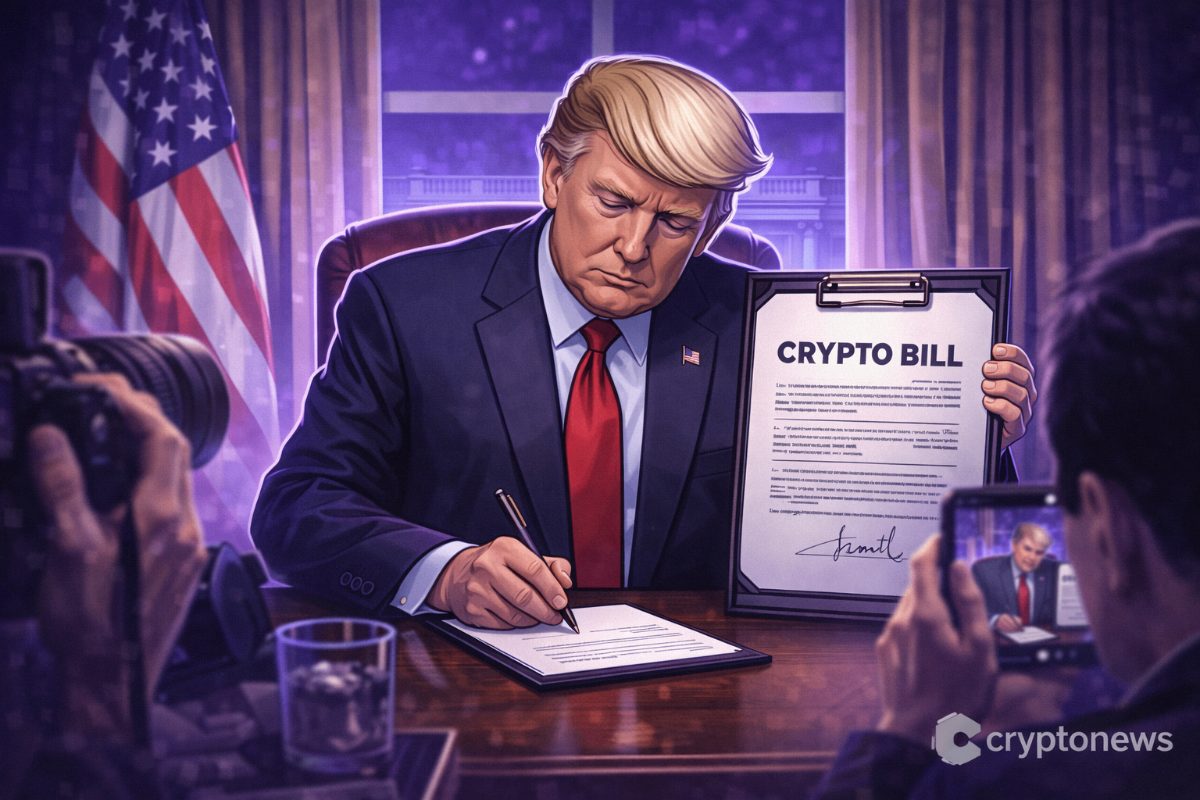
President Donald Trump has agreed to roughly eighty percent of a stringent bipartisan ethics proposal tied to major cryptocurrency legislation heading for a key vote. According to Republican senators, the updated measure includes a meaningful enforcement role for state attorneys general and strict financial divestment rules.
President Donald Trump has agreed to a significant portion of a strict ethics proposal integral to broader cryptocurrency legislation heading toward a crucial floor vote, according to three of the bill’s primary Republican authors. The sweeping legislative package initially featured only a provision barring federally elected officials, their spouses, and federal judges from issuing digital assets.
However, a core group of lawmakers including Sen. Thom Tillis, R-N.C., and Sen. Ruben Gallego, D-Ariz., alongside several other Democrats, argued that the original restriction fell short of addressing conflict-of-interest concerns regarding Trump’s cryptocurrency wealth. Their support is necessary to advance the bill in a key vote, setting up intense negotiations over enforcement mechanisms and financial transparency.
State Attorneys General Enforcement Powers and White House Concerns
Tillis, Gallego, and various Democratic lawmakers had pressed for language that would empower state attorneys general to enforce the law alongside the U.S. Department of Justice. Republican Sens. Cynthia Lummis of Wyoming, Tim Scott of South Carolina, and John Boozman of Arkansas announced that Trump agreed to a measure granting a meaningful role for state attorneys general to enforce the legislation if enacted.
According to a senior GOP aide who briefed reporters on the condition of anonymity, the president agreed to roughly eighty percent of the proposal put forward by Tillis and Gallego. The updated text permits state attorneys general to initiate lawsuits against crypto exchanges that list digital assets barred under the comprehensive bill.
Private discussions within the White House initially revealed hesitation regarding state-level enforcement. Officials worried that Democratic state attorneys general might wield the authority as a political weapon against the president and other Republican officials, while Republican state lawyers could similarly target elected Democrats.
Divestment Mandates and Blind Trust Requirements in the Clarity Act
The updated legislative text released includes a strict requirement for officials to either divest or place significant financial interests in a blind trust. Specifically, the provision targets any substantial financial holdings in entities that issue cryptocurrencies, according to the senior GOP aide.

White House crypto adviser Patrick Witt highlighted the administration’s flexibility during the legislative process in a public statement on X. At every step of the way during the Clarity Act negotiations, the White House and Senate Republicans have been responsive to Democrats’ stated policy objectives,
Witt wrote.
After more than a year’s worth of negotiations, it’s time to pass this bipartisan bill.
Patrick Witt, White House crypto adviser
As negotiators finalize the legislative framework ahead of the scheduled vote, aides to both Sen. Gallego and Sen. Tillis did not immediately return requests for comment regarding the updated ethics agreement.
Читайте также

