
Almost half of Victoria’s government-managed roads were rated in poor or very poor condition in a new auditor-general’s report released on Wednesday, September 9, 2026. With road deterioration outpacing repairs and thousands of unrepaired potholes reported statewide, transport funding has emerged as a central flashpoint ahead of the November 28 state election.
Victoria’s crumbling infrastructure has turned into a dominant political flashpoint ahead of the November 28 state election, as motorists face mounting car damage, tyre blowouts, and safety hazards on regional and metropolitan networks. A damning report tabled in state parliament by the Victorian Auditor-General’s Office examined more than 23,000 kilometres of major arterials managed by the Department of Transport and Planning and found that almost half of the state’s roads are in poor or very poor condition.
Auditor-General Report Reveals Accelerating Road Decline Across Victoria
The auditor-general’s findings show that the share of state roads rated in poor or very poor condition jumped to 48 per cent in 2024, a sharp increase from 39 per cent in 2021. According to the report, current funding levels force the government to focus primarily on reactive and safety-critical patches rather than preventative maintenance.
Data from 2024 reveals that more than a third of state-managed roads have a mere five years of useful life remaining before deteriorating beyond safe usage without reduced speed limits or vehicle load restrictions. Another 10.5 per cent retain between five and 15 years of useful life.
Conditions are significantly worse in regional municipalities. In the Loddon Mallee region, 69 per cent of state-run roads are classified as poor or very poor. Hume records 57 per cent, and the Grampians sit at 48.6 per cent.
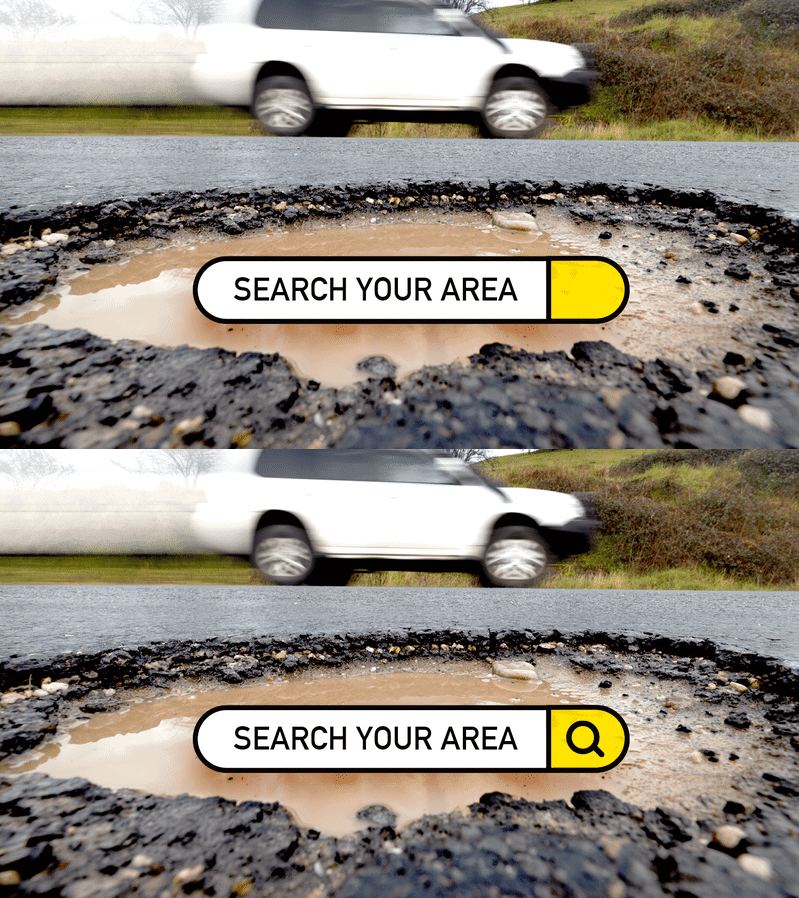
Statewide, there are 8,049 unrepaired potholes logged across the network. Regional shires bear the heaviest brunt: Towong records 445, Moyne registers 386, and Mornington Peninsula counts 382. In Melbourne, outer-suburban Melton leads the metropolitan area with 250 unrepaired potholes.
Funding Shortfalls and the Growing Gap Between Defects and Repairs
The auditor-general found that road defects are multiplying faster than maintenance crews can fix them. Between January 2025 and June 2026, the backlog gap between recorded defects and completed repairs doubled.
Internal business cases from the Department of Transport and Planning state that maintaining pavement conditions while replacing ageing assets requires more than $3 billion a year. However, the government allocated only $1.04 billion in the 2026-27 budget, while forecasting billions in interest payments on state debt for the same financial year.
The deteriorating road network has triggered heavy public frustration. Toby Ralph, an election marketer and researcher who has worked globally, noted that crumbling infrastructure serves as unavoidable political advertising regarding state finances.
“They’re omnipresent, impossible to spin, and while motorists don’t study the state budget when they hit a pothole, they ask: with all the money being spent, why can’t you fix this?”
Toby Ralph, Marketer and Researcher
Political Fallout and Competing Election Pledges
Political pressure intensified following recent incidents, including an August report that 23 Victorian drivers received compensation from the Transport Accident Commission for pothole damage over two years despite thousands of complaints, and an incident in July where seven cars were forced off the Calder Freeway near Gisborne due to tyre damage.
Insurance Council of Australia chief executive Andrew Hall reported a higher volume of tyre and rim blowout claims in Victoria compared to other states. Meanwhile, lobby group Fix Victoria distributed bumper stickers reading Not drunk, avoiding potholes
outside Parliament station.
Premier Ben Carroll, who assumed office in July, announced an additional $352 million to fix 500,000 potholes by the end of January using deferred infrastructure funds and prison labor. Carroll also pledged to bring major road maintenance back under direct government control, shifting away from reliance on four external contractors identified by the auditor-general.
Roads Minister Paul Hamer defended the administration’s record, stating that the government had record investment over recent years while acknowledging the need for further action.
“We’ve had record investment over the last few years … but we need to do more. We’re not shying away from that.”
Paul Hamer, Roads Minister
Opposing the government, the Liberal-National Coalition has pledged a $5 billion package over four years to rebuild roads and repair a million potholes. Shadow roads minister Danny O’Brien criticized the incumbent administration for generating potentially catastrophic safety risks for motorcyclists and vulnerable road users.
Rural Councils Victoria, representing 35 regional shires, previously sought an additional $500 million over four years. Campaspe Shire councillor and group chair Rob Amos warned that failing to adequately fund immediate maintenance will only shift massive costs onto future budgets.
Читайте также
